Sustainability is often discussed in terms of targets, reporting frameworks and compliance. But sometimes the most effective sustainability initiatives are the simplest.
At Maynooth University, food waste generated on campus is not viewed as waste at all. Instead, it is treated as a valuable resource that can be returned to the very landscape from which it came.
Working in partnership with Thorntons Recycling, the university has developed a closed-loop organic waste system that demonstrates circular economy principles in action.
From Campus to Compost
Every day, organic material is collected from dining facilities, student accommodation and other areas across the university campus.
Rather than being disposed of as general waste, this material is carefully segregated and collected for processing through Thorntons Recycling's dedicated composting facility.
There, the organic material undergoes a controlled composting process, transforming food waste into a nutrient-rich compost suitable for agricultural, landscaping and horticultural use.
Closing the Loop
The real success of this project comes when the finished compost returns to Maynooth University.
The compost is used by the university's grounds team across lawns, flower beds and heritage landscapes, helping to improve soil quality while reducing the need for synthetic fertilisers.
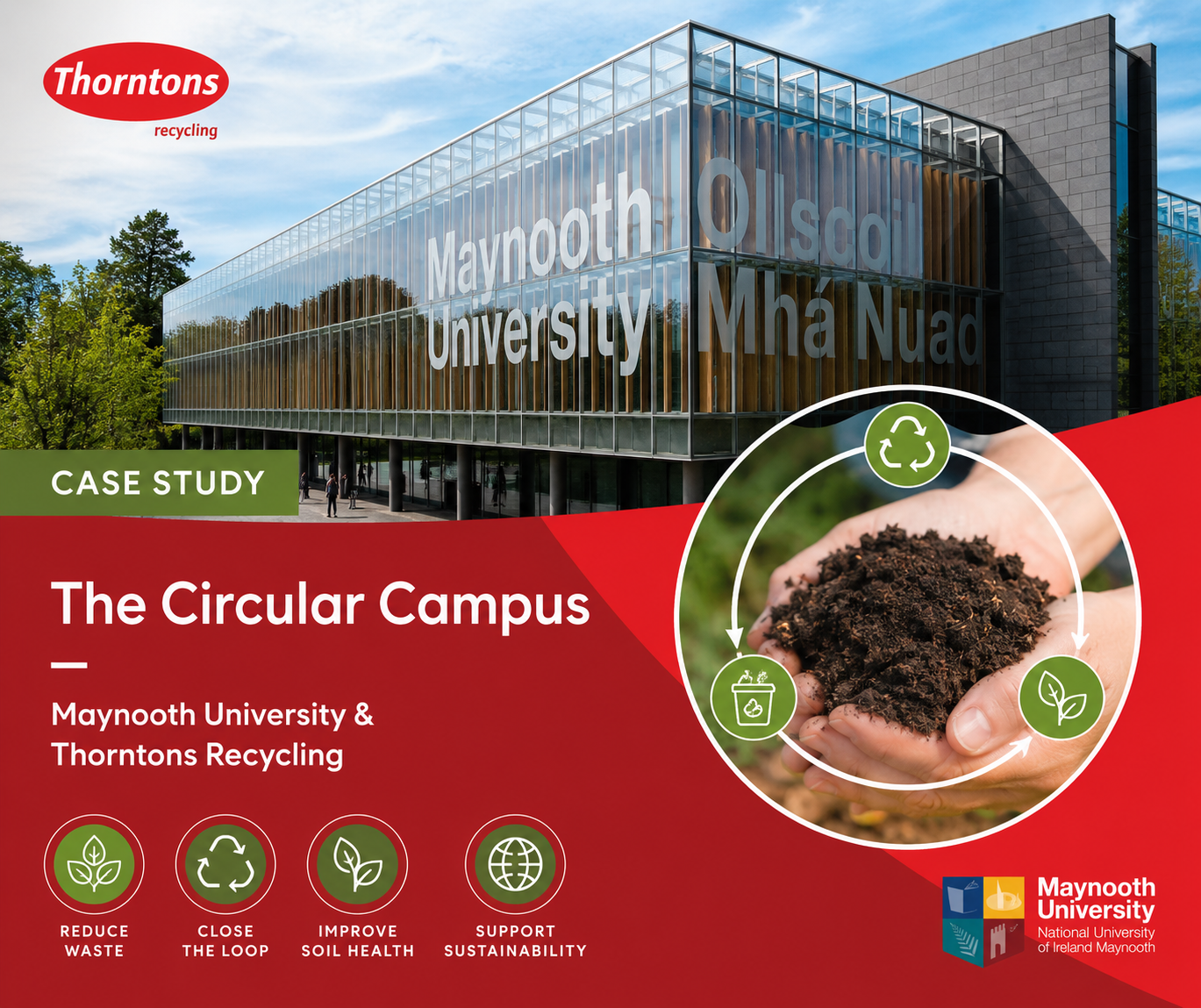
This creates a truly circular system:
➡️ Food is consumed on campus
➡️ Organic waste is collected and processed
➡️ Compost is produced
➡️ Nutrients are returned to the soil on campus
The result is a practical example of how organisations can move away from the traditional "take-make-dispose" model and towards a more sustainable future.
Delivering Real Environmental Benefits
The partnership has helped Maynooth University:
✅ Reduce general waste volumes
✅ Divert organic material from disposal
✅ Support Green Campus objectives and wider sustainability commitments
✅ Improve soil health and biodiversity across the campus grounds
✅ Demonstrate circular economy principles in a visible and measurable way
Sustainability Through Partnership
Projects like this show what can be achieved when organisations look beyond waste collection and focus on resource recovery.
At Thorntons Recycling, our goal is not simply to remove waste. It is to help our customers find practical ways to reduce environmental impact, improve resource efficiency and support their sustainability ambitions.
Maynooth University's Circular Campus initiative is a great example of how food waste can become a valuable resource, creating environmental benefits for today while helping to build a more sustainable future for tomorrow.
The Case Study can be downloaded by clicking here!